
Untitled
Asia Society
HOME CALENDAR RESOURCES SUPPORT ABOUT VISIT ASIASTORE SEARCH
Resources

A Governor Looks at Asia

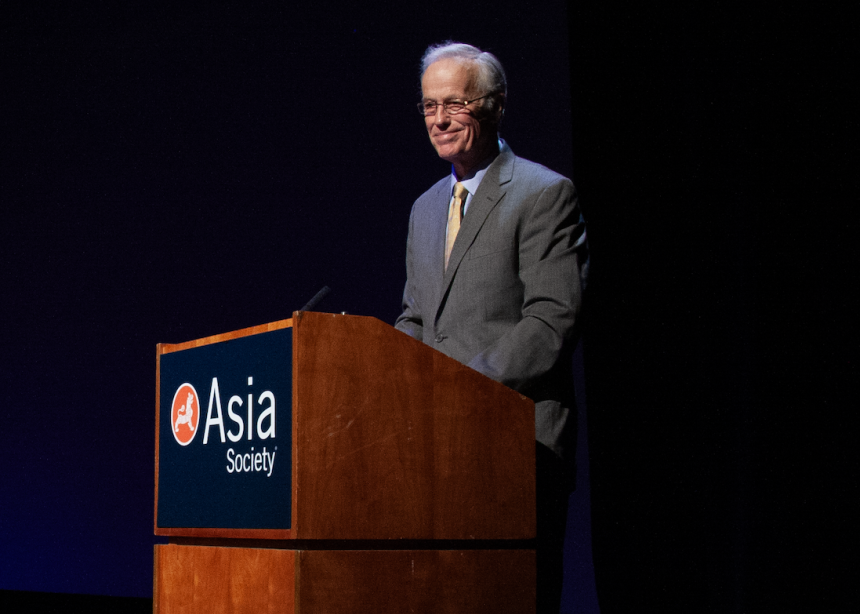
Mark Warner
Governor of Virginia

New York, November 28, 2005

…I'm grateful for the invitation and I'm grateful for all of you being here, particularly on the first workday after Thanksgiving.

I am going to try, at least in my initial comments -I will be happy to answer any questions later -to really try to stay focused on that issue of "all right, what it is like to look at Asia from a governor's perspective?"

Clearly there are enormous issues and a series of complex challenges on a variety of fronts.

Nuclear proliferation obviously continues to be a tremendous challenge - particularly when we see places like Iran and North Korea that have shown very little interest in sustained involvement with our country.

Islamic extremism is a challenge that confronts us not only in the Middle East, but as we all know increasingly in places like Thailand and the Philippines and Indonesia.

A subject that I'll spend some time on today - the whole question of outsourcing. As we see the emergence of China and India and the phenomenon of moving jobs that initially were manufacturing jobs, but increasingly, in a state like Virginia--we have kind of a bifurcated economy of traditional manufacturing and some of our older industries in the Southwest, and we believe, one of the most cutting-edge IT, telecom and technology growing economies in the northern part of our state--Increasingly we see the challenge of job outsourcing moving from manufacturing to IT jobs.

On the health front, we see an enormous emergence of issues that range from AIDS, to SARS to avian flu and other pandemic flus. And I would add that in my first year as Governor we had an enormous outbreak of avian flu in our Shenandoah Valley, luckily it didn't make it to the human population, but I grappled with that firsthand.

And unfortunately, I think we would all understand that we find ourselves -- in this country -- facing Asian countries, organizations, and people who have a diminished view of the United States.

And while in certain countries, for example Indonesia, the good efforts of people in the aftermath of the tsunami, and perhaps in increased efforts to aid the relief efforts in Pakistan, we see individual country turnarounds. But on a more global perspective, America's standing in too much of Asia is at an all-time low.

Now in the face of these challenges and many others, it's easy to move into that position where the U.S. looks with fear toward Asia -- and unfortunately many in this country have chosen that route.

But I believe it's a much more complex situation and I believe that there are enormous opportunities to see Asia as an emerging partner for our country on a host of fronts.

Now as Governor, I came into office after two decades in business, and I see enormous opportunities particularly on the economic front --if we make the right decisions on our relations with Asia.

These decisions mean that while we must continue to confront the challenges that I laid out, and a host of others, we must not simply build our relationship by solely focusing on areas of disagreement, but instead find common points of agreement.

This has been Virginia's approach as I've traveled the region in our development of economic ties between Virginia and countries in Asia.

Virginia Governors have been traveling to Europe for generations. But I wanted to focus on Asia in terms of establishing stronger economic ties between our Commonwealth and this emerging enterprise.

As a matter of fact, there are only seven states in the country that are home to more people of Asian descent than Virginia.

It's no accident that Virginia has full-time offices to promote trade and shipping in Tokyo, Seoul, Singapore, and Hong Kong. And most recently, we're looking from a state standpoint to open offices in India and our largest county already has an operation in Bangalore.

Over the past four years… As Governor economic development and economic trade has been a great focus so I have led missions to Europe, Mexico, Japan, China, and India.

Now in terms of Virginia's relationships with Asian countries, they're at different levels of maturity.

Today, Japan is Virginia's third-leading international trade partner, and we have relationships that are deep and longstanding.

And I believe from a Virginia standpoint and from a national standpoint, we need to maintain these strong relations with our traditional ally, because we have so many shared common interests - even as we see the emergence of so many other economies throughout the region.

We're working to strengthen ties with both China and India. China now ranks as Virginia's fifth- leading trade partner. In fact, Virginia does more export business with China than with the United Kingdom.

While we are seeing we are not immune from that trade balance sometimes going in a difficult direction, I can't help but think of my trade mission to China visiting Ningbo, south of Shanghai. I saw the enormous pressures that community is facing from wage rates in the Western part of China as jobs that have migrated perhaps from the United States to the Eastern Coastal regions are now starting to migrate even further west into China. An issue that I think, again, presents both challenges and opportunities.

In India, trade between India and Virginia has exploded. Virginia's exports to India are rising dramatically - increasing 135% in 2004 over the previous year.

I had the opportunity to be the first American governor to visit India in the last three years. Virtually every American governor has visited China, but I think at times we ignore India to our peril. We led the largest state delegation from the U.S. there ever. I remember visiting Prime Minister Singh and talking about the challenges and opportunities, and he reiterated the point that came out time and again on my visit of the enormous economic explosion taking place in India. Twenty-five million more Indians are moving into the middle class each year.

As I think of India, or for that matter, China, there was one story that stuck with me more than any of the particular meetings with government officials or business officials-more than visiting the Great Wall or the Taj Mahal.

I had been taken into one of the worst slums in Delhi. It was kind of the epitome of a third world slum-dirt floors, shacks with corrugated tin roofs, no running water. Many of the children there spent their day begging rather than going to school.

I visited an NGO called the Hole in the Wall project. This Hole in the Wall project was simply where the NGO had come in and put a series of computers into a brick wall-and would turn them on in the morning and turn them off at night. There were no teachers, no training. It was definitely to see what would happen. I mean I'm a visiting American dignitary and they had rolled out the red carpet and a young kid named Samir grabbed me and said, "Tell me your name, tell me your name." I said, "My name is Mark. Why do you want me to tell you my name?" He said, "Well, I want to Google you to find out if you're important." And I had two reactions.

The first reaction was to think, "Isn't this incredible? Here is American technology half way across the world helping to empower these poverty-stricken children to play a role in this global economy." But again to be honest, I have to tell you that feeling was followed up pretty quick by the fact that Samir and all those kids have an innate ability-an ability to master this technology-and suddenly time and distance disappear between Delhi and Richmond. And it's very much a reality that Samir is going to be in competition for the same jobs as kids in Virginia. Kids like my daughter.

And what we see is that the race is on for the future.

India and China in different ways are caught between two worlds-emerging in very dramatic ways on the technology-driven world stage. They're caught between the past and the future. The message I bring back more than any other is that the race is on for the future. Who's going to get there first? Who's going to own it?

As I've gotten to start a conversation from a political standpoint around the county, as a Democrat in a very red state, I often talk to folks about the fact that I don't believe policy issues in our country are going to be divided as left vs. right or liberal vs. conservative anymore. More and more are going to be divided by those policymakers who understand the challenges and opportunities of the future vs. those who are still caught in the past.

That same analogy can be made in terms of our relations with Asia. I don't believe it's going to be East vs. West-China vs. the U.S.-India vs. China. Again, it's going to be this future/past dynamic.

Folks, there are two questions. First, how do we maintain Virginia's, and for that matter -- the United States' -- competitive creativity and intellectual capital in this world where Shanghai and Southwest Virginia are competing on a soon-to-be a very level playing field?

And second, speaking parochially for a moment, how do we make sure we create that most educated, most innovative, most entrepreneurial workforce so that some of those jobs and economic opportunities are not simply flowing in one direction but actually can flow back into this country? And from a Governor of Virginia's standpoint, back throughout Virginia, and not just back into Virginia in our already prosperous areas at the northern part of the state.

Now we'll talk for a couple more minutes about both of these questions and what we've got to confront. The stacks are enormously, enormously high. And on both of these issues, I'm not sure, and I say this now as the Governor of Virginia-I'm not sure we're fully prepared.

Consider this: At a time when commitment to education, technology, and R&D has never been more important, American research and development as a percentage of our GDP has fallen to sixth in the world. The United States ranks 11th in the world in broadband deployment.

Fewer than 15 percent of our students go on to careers in higher education in math or science.

India alone produces four times more engineers each year than the United States. Our 15-year-olds now rank 28th in the world in math scores.

I had the honor of just finishing up a chairmanship of the National Governors Association. I took as my year-long chairman's initiative a look at a major re-working of America's high schools-which are not fully preparing our students, whether they're going on to college or going into the workforce.

We held a national seminar on this issue and brought in Bill Gates as our keynoter. He reemphasized the fact that American students do pretty well up to fourth grade in national comparisons, but start falling off by the eighth grade. And by 12th grade, we increasingly are miles behind. And we must -- if we're going to remain competitive -- we must have that best educated workforce.

So what have we done about that in Virginia?

We've done a couple of things. Now, in every high school in Virginia you can earn a minimum of a semester's worth of college credit in high school and have it fully transferable to UVA, Virginia Tech, and William & Mary. And by having that emphasis we've now seen in Virginia the largest increase in math SAT scores of any state in the country. We had one of the largest increases in the number of students taking AP courses… Raising the bar, going the extra mile on remediation, and putting that focus on the areas that we need to remain competitive.

We've also taken an area with career and technical education and acknowledged that maybe not every kid is going to go on to a higher education institution. We've done something a little different. We now offer in every high school in Virginia, if you're not college bound, the opportunity to earn an industry certification along with your high school diploma. And if that takes up to a semester at a community college-we'll pick it up for free as part of your basic K-12 package. That turns somebody from flipping burgers into working as a computer technician, a nurse's aide--$7,000 additional income.

In our colleges and universities we totally reworked and put forth the most aggressive higher education restructuring in the country. Part of our higher education reform requires every Virginia college and university to put more emphasis on research and development. While I only have about 50 days left as governor, I'm also launching the most extensive-I've got another budget to put forward-the most extensive R&D commitment from the state in Virginia history.

Again, how do we stay competitive?

Part of our challenge as well, and I say this from a standpoint of trade as we examine issues surrounding outsourcing--back in July, the New York Times ran an editorial entitled, "Look to Virginia, Not China" in terms of how we deal with this in our ailing communities.

We have, I think, the largest rural broadband initiative going on anywhere in this country right now. All through Southside and southern Virginia-areas that have been tobacco, textiles, furniture-not exactly growth industries at this point. Places where we are making sure these communities don't get left behind.

In a state that is increasingly R&D driven, we still have 700,000 working-age Virginians without even a high school diploma. So, we've taken a whole new approach. We've actually partnered with NASCAR to get folks to get involved in an initiative called Race to the GED, to go back as working-age adults, to get those GEDs. In the last three years, 35,000 more adults have gotten those GEDs-a 28 percent increase-and suddenly you're taking folks who might not have had any future in these changing times and given them some hope.

I want to talk about this because it is a piece of what we're going to have to do with Asia in terms of our economic competitiveness.

At our National Governors conference. we had experts from China and India talking about their education systems and how we often times commend very appropriately the output of engineers and scientists. But in both China and India, less than half of the population even graduates from high school. Yet, if we look at what the Conference Board reports, within a decade, those high school graduation rates may approach European and U.S. graduation rates. It is increasingly incumbent upon us to make sure education, as a national security as well as an economic security issue, has to be one of our top national issues.

We must understand, if we're going to stay competitive, education has to be at the forefront of any discussion about how we deal with all of the countries in Asia.

Second question was how do we make sure this flow of jobs and opportunities is a two way street. Clearly, I don't believe we can sit back and simply watch jobs disappear. I dare say it has to be a piece of the debate. But to think that somehow we're going to go back to the world where knowledge and information can stop at borders-or simply putting up new tariff structures or ones that restrict trade-I believe does not play to the long-term interests of the United States.

As I met with folks in India, the challenge I tried to lay out was as Indian companies look at reinvesting back into the United States, my hope would be that these companies would not simply invest in opportunities in Silicon Valley, New Jersey, or Northern Virginia-but look at opportunities as well in rural communities.

The case I made was the analogy back to Japan. My belief was when Japanese auto manufacturers decided 20 years ago to invest in the United States, they decided not to invest and build those manufacturing facilities around Detroit. Instead they built in places like Tennessee and Kentucky. Now, $9 billion later, Tennessee ranks second only to California in Japanese investment.

In a certain way there may be opportunities for us to learn from some of our Asian country counterparts about how to crack the code of building those knowledge-based facilities, or IT-based facilities in the Roanoke, Virginias or the upstate New Yorks. If it can be built in Bangalore, I truly believe it can be built in communities throughout America that are often times at the forefront of the fear surrounding globalization and trade issues.

Again, we've got an example to point to. That was a large Indian company, Essel Propack, that actually picked Danville, Virginia-the heart of the tobacco region in our Commonwealth-to put a major manufacturing facility. That manufacturing facility in Danville has done more to change the feelings of people in Southside Virginia about some of the upsides of international trade than anything else.

Now clearly, there's much more than the economic challenges that I've laid out. In the past, I think governors might have only looked at foreign countries as a place for their domestic industries to sell products to. I believe governors will increasingly be at the forefront of recognizing that in this global economy-because governors serve as chief economic development officers of their respective states, we often bring a very different perspective than members of Congress. I think increasingly you're going to find that governors understand that educational component. It's that requirement to see about trade going in both directions and that foreign reinvestment back into the states as key aspects of leading our economic development efforts.

I would add as well, thinking back to Samir in Delhi, that increasing prosperity for the Samirs of the world is absolutely in the United States' best long-term interest. Our challenge is to make sure that we see that opportunity and recognize that the only way we're going to do that is through a partnered relationship. There's a lot at stake. It won't be easy.

You're in this room because you're concerned about U.S.-Asia relations and you care enough to come the first business day after Thanksgiving to have this dialogue. It's incumbent upon us for not only Asia's long-term prospects -- but more importantly for the United State's long-term prospects, that we get it right. I think if we win that race for the future, if we see the challenges in a new light, we will get it right. Now we just have to go about doing it. Thank you all.

# # #