
|
The Future of China-U.S. Relations
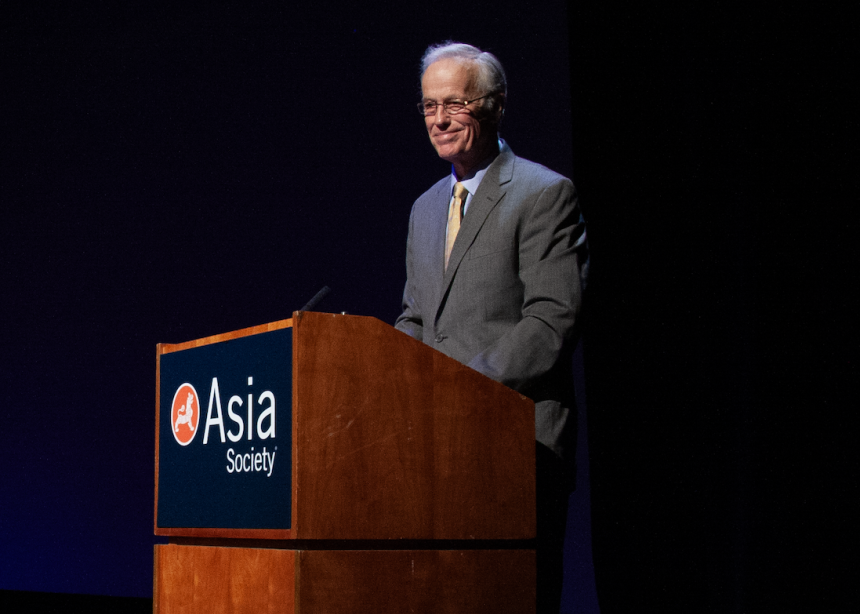
H.E. Zhou Wenzhong
Ambassador of the People’s Republic of China to the United States
New York, September 22, 2005
Dr. Desai,
Ladies and Gentlemen,
Friends,
I wish to begin by thanking the Asia Society for its kind invitation, which gives me the opportunity to attend this luncheon and meet with so many friends, old and new.
Now, the relations between China and the United States are at an important juncture. President Hu Jintao and President Bush agreed during their meeting in New York City last week that China and the U.S. should strive to enhance mutual trust and strengthen cooperation so as to advance their constructive and cooperative relationship in the 21st century in an all round way. They have indeed pointed the direction in which China-U.S. relations should go.
In my view, in order to implement the agreement between our heads of state and push forward the bilateral relations, our two countries should handle the following questions appropriately.
First, evaluation of China-U.S. relations over the past 26 years
A brief review of the history of China-U.S. relations will easily reveal that the growth of the relations conforms to the fundamental interests of our two countries and benefits peace, stability and development in the Asia-Pacific region.
In the early days of our diplomatic relations, there was no inter-governmental cooperation agreement at all between China and the U.S. Today, we have over 30 such agreements between us.
In 1978, two-way trade totaled merely 990 million U.S. dollars - less than one billion - and mutual investment was virtually zero. Last year, our trade volume reached over 169 billion U.S. dollars.
China is now the most important market for U.S. industrial goods as well as agricultural produce such as aircrafts, fruit and soybean. Compared with only 18% growth of total U.S. export over 5 years from 1999 to 2004, U.S. export to China grew by 169% in the same period.
The number of U.S.-invested projects in China has topped 40 thousand, with a total paid-in investment of 50 billion U.S. dollars. Some Chinese companies have also set up business in the United States.
As our relations moved forward, our two countries also grew rapidly.
The U.S. completed the transition from an industrialized to a post-industrialized country. Its GDP rocketed from 2.29 trillion U.S. dollars in 1978 to 11.75 trillion in 2004 and its per capita GDP from 10,294.5 U.S. dollars to 40,100 U.S. dollars. The U.S. became the world's only superpower after the collapse of the Soviet Union, with both its role and influence in the world strengthened.
During the same period, China continued to press ahead its reform and opening-up policy, realizing sustained economic growth and social progress and bringing about fundamental changes to the outlook of the country. From 1978 to 2004, its GDP grew from 150 billion to 1.65 trillion U.S. dollars, and its per capita GDP from 190 to over 1,200 U.S. dollars. Import and export total soared from 20.6 billion to 1.15 trillion U.S. dollars. China is making constant progress in building a democratic and law-based society and in various social undertakings.
Therefore, China and the U.S. can benefit each other, grow together and both emerge as winners. The development of our relationship is in the fundamental interests of our two countries as well as our peoples. It has and will continue to have the wide-ranging support from our governments and peoples. It is capable of removing the disruptions and moving ahead.
Second, broad mutual interests on strategic and security issues serve as the bedrock of our cooperation.
The world today is far from being tranquil. Human society is still faced with grave challenges in the course of its development. Armed conflicts and regional wars arising from territorial, ethnic, religious and resources disputes have been going on with no end in sight. Terrorism remains a serious threat. Environmental pollution, the spread of major epidemics and various cross-border crimes have brought new threats to people of China, the United States and the rest of the world.
As the biggest developing country and the biggest developed country of the world, China and the U.S. both have significant influence in maintaining peace and prosperity in Asia-Pacific and the world and in promoting global economic growth. In this new historical period, it is essential for China and the U.S. to work together for greater peace, stability and security in the world by continuing and deepening their cooperation on a host of traditional and non-traditional security issues such as counter-terrorism, non-proliferation, Asia-Pacific affairs, cross-border crimes and epidemics.
Our current cooperation on counter-terrorism and non-proliferation is effective. We are seeing a smooth running of our counter-terrorism consultation and mechanisms, and ever increasing areas and ways of cooperation.
In Asia-Pacific affairs, we are also cooperating effectively. At the Six-Party Talks a couple of days ago, the Joint Statement was adopted thanks to the concerted efforts of China, the U.S. and other parties. This is of major significance to peace and stability on the Korean Peninsula.
In the reconstruction of Iraq and Afghanistan, in the Middle East peace process and on UN reform, we are having fruitful consultation and coordination.
On a host of global issues including cross-border crimes, HIV/AIDs, acute epidemics, and environmental degradation, we are making constant new progress in our cooperation.
Take a look at the trail China left behind over the past decades and you will see that China is sticking to a road of peaceful development, namely, taking advantage of the relative peace in the world to develop itself and working for greater peace in the world as it becomes more developed. China never seeks hegemony. China never dreams a "Soviet Union dream".
Here is what I wish to stress in particular. China is resolved to transcend the traditional development approaches that big powers took in modern history and the cold-war mentality marked by ideology. Instead, we are ready to work together with everyone in the world to achieve peace, development and cooperation among all nations.
China pursues a national defense policy of a defensive nature. Our defense budget for 2005 was some 29.56 billion U.S. dollars, far less than all the major powers of the world in both aggregates and per capita terms. Taking the road to peaceful development is a historic choice of the Chinese people as this best serves our national interests. No matter how the international situation may change, we will steadfastly follow this road.
China's large population, weak economic foundation and regional imbalance mean that its road to development is strewed with numerous contradictions, difficulties and challenges. There is a very long way to go before we achieve modernization and the Chinese people become relatively well-off. Therefore, China is committed to building long-term and stable cooperative relationship with the rest of the world, the U.S. included, and working together with them to maintain and promote regional and world peace, stability and prosperity.
China respects U.S. interests in the Asia-Pacific region and welcomes its active and constructive role in Asia. So do we believe that China and the U.S. are fully capable of cooperating more closely for a mutually beneficial and win-win result.
Third, a mutually beneficial and win-win situation is completely feasible.
The 26 years of diplomatic relations have witnessed growing trade and economic cooperation between China and the U.S. Two-way trade has increased by over 60 times. Today, the U.S. has become China's second largest trading partner, and China the third largest trading partner and the fastest growing export market for the U.S. Such increasingly close ties have brought enormous and tangible benefit to our peoples and boosted global economic growth.
It must be pointed out that mutual benefit is the mainstream of our trade and economic relations. But frictions are unavoidable given the fast growth and large scale of China-U.S. trade.
We are ready to settle the trade disputes with the U.S. appropriately through dialogue and consultation based on the principle of equality, mutual benefit and common development so as to facilitate the sound development of the bilateral trade and economic cooperation. We attach importance to the U.S. concern over trade imbalance. It is our desire to open our market further to the U.S. products in accordance with our WTO obligations and work together with the U.S. side to reduce its trade deficit.
China will step up the protection of IPR, strengthen enforcement against various infringements in accordance with the law, and protect the legitimate rights and interests of the IPR holders all over the world, including in the U.S. Apart from being the biggest buyer of American soybean, wheat and cotton, China is also buying enough Boeing aircrafts to equip 70% of its civil aviation fleet. We will continue to import more from the U.S. in order to reduce our surplus. At the same time, we hope the U.S. will continue to champion the cause of free trade rather than protectionism and take positive measures to help balance our trade, such as lifting its restrictions on hi-tech export to China.
China-U.S trade and economic interaction and cooperation are expected to increase further.
Fourth, people to people exchanges offer vast potential.
The friendship between China and the U.S. dates back to a long time ago. The friendly sentiment between the peoples of our countries runs deep.
When Hurricane Katrina hit southern American states not long ago, the Chinese people feel for victims of the disaster. No sooner had Katrina struck than President Hu Jintao extended sympathy and condolences to the U.S. Government and people on behalf of the Chinese Government and people. The Chinese Government quickly provided emergency relief material and 5 million U.S. dollars cash to the victims. This is a fresh testimony to the friendship between the peoples of China and the United States. I wish to take this opportunity to again extend sympathy and condolences to the victims and hope they will rebuild their homeland at the earliest possible date.
Since the establishment of diplomatic ties, 37 pairs of sister provinces/states and 123 pairs of sister cities in China and the U.S. have been twinned. Over 180,000 Chinese have studied in the U.S. and right now, 60,000 are still studying here. About 3,000 Americans are studying in China, forming the third largest overseas student community. Personnel movement between the two sides totals 1.75 million person/times per year or 5,000 per day. There are now 54 flights every week operated by Chinese and U.S. airlines and that number is going to increase to 249 by 2010.
In elementary schools, high schools and colleges in China, the vast majority of students, or 120 million, are learning English. In the U.S., some 1,000 colleges and over 200 elementary and high schools are offering Chinese language courses and there are some 600 Chinese language schools run by overseas Chinese or Chinese Americans.
This October, Chinese Ministry of Culture and the Kennedy Centre of Performing Art will jointly stage The Festival of China, a cultural event where over 600 artists from China are going to give performance or hold exhibition. This Festival is going to be another major event in the cultural exchanges between our two countries.
I am confident that, with the concerted efforts of both countries, our cooperation and people-to-people exchanges in the fields of culture, education and law enforcement will continue to reach one new height after another.
Fifth, approach to differences over such questions as Taiwan, human rights and religion
1. Taiwan question. It is the shared interests of China and the U.S. to maintain peace and stability in the Taiwan Straits. The Chinese side highly appreciates the reiterated position of President Bush and the U.S. Government of sticking to the one China policy, abiding by the three Sino-U.S. Joint Communiqués and opposing "Taiwan independence".
I wish to stress here that the Chinese Government is sincere about improving and developing relations across the Taiwan Straits and promoting the peaceful reunification of the motherland. And it is determined to do so. There are three basic considerations in our policy on the Taiwan question.
First, promote cross-straits relations. We are ready to have dialogue or exchanges with anyone or any political party in Taiwan recognizing the 1992 Consensus, which embodies the concept of the Mainland and Taiwan belonging to the one and same China. Since early this year, we have invited the leaders of KMT, PFP and New Party for visits on the Mainland. Agreements were reached with them on strengthening exchanges between the two sides and other matters. This is a good example of our sincerity in improving and promoting relations across the Taiwan Straits.
Second, maintain peace in the Taiwan Straits. The secessionist activities aimed at "Taiwan independence" pose the biggest threat to the peace and stability in the Taiwan Straits. The very purpose of our firm opposition against "Taiwan independence" is to remove the hidden danger of and root cause to any possible conflict in the Taiwan Straits.
Third, work for peaceful reunification. Resolving the Taiwan question by means of peaceful reunification is in the best interests of the people on both sides of the Taiwan Straits and is most effective in maintaining stability and prosperity in the Asia-Pacific region. As long as there is a gleam of hope for peaceful reunification, we will never give up such efforts.
While actively working to improve relations across the Taiwan Straits and maintain peace and stability there, we hope to have the understanding and support from the U.S. side shown in a firm opposition to "Taiwan independence" and an end to the sale of advanced weapons to Taiwan. This will be conducive to the sound and steady development of China-U.S. relations.
2. Human rights question. The Chinese Government attaches high importance to the protection and advancement of human rights. The people in China are enjoying more substantial human rights than ever before.
Rural village committees and urban resident committees are now directly elected. In March last year, the National People's Congress wrote into China's Constitution such contents as "the State respects and protects human rights" and "legally obtained private property of the citizens shall not to be violated". China has already signed 21 international conventions on human rights and is conducting dialogues on this subject on the basis of equality and mutual respect with many countries, the U.S. included.
The Chinese Constitution provides for freedom of religious belief of all citizens. The religious groups, places of worship and the legitimate rights and interests of the followers and their normal religious activities are protected by law. In China, there are roughly over 100 million religious followers, over 100,000 places of worship and about 300,000 clergy of different religions. A total of over 35 million copies of the Bible have been printed.
In short, it is obvious to all that China has made remarkable progress in protecting human rights and religious freedom.
Of course, we have not done perfectly. There is still room for improvement. But we are striving for constant progress. We are ready to have dialogue with the U.S. side on these questions and to make them another positive element in our bilateral relations.
Ladies and Gentlemen,
The Chinese side highly values China-U.S. relations and firmly commits itself to building a constructive and cooperative relationship with the United States. We are ready to work in concert with the U.S. side on the basis of mutual respect, equality and mutual benefit, always grasp the overall situation of our bilateral relations from a strategic height, strengthen dialogue, mutual trust and cooperation, and respect and address each other's concerned.
The future of China-U.S. relations is promising. But this promising future will not come automatically. Its materialization depends on the attitude we adopt and the choices we make today. In making the choices, we must stand on a high ground and look far. We must have a clear vision of the mainstream of China-U.S. relations and the trend of the times. We must build on our consensus, expand cooperation and promote an all-round constructive and cooperative relationship between China and the United States.
Thank you.
|