
Untitled
Asia Society
HOME CALENDAR RESOURCES SUPPORT ABOUT VISIT ASIASTORE SEARCH
Resources

The Importance of Protecting Civil Rights and Civil Liberties
Asian American Speakers Series

Congressman Mike Honda
(D-CA)

Washington, DC, May 12, 2004

Special thanks to Federal Express for sponsoring this wonderful luncheon.

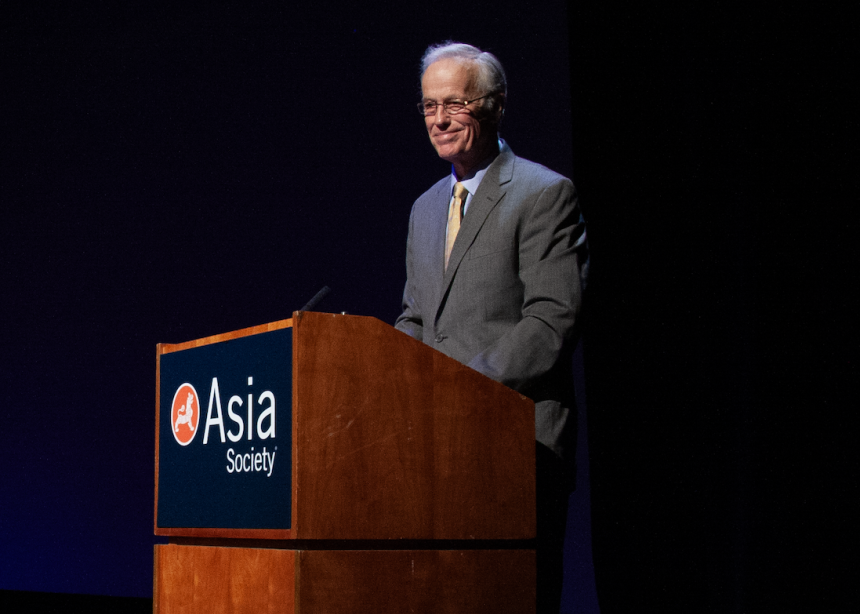
Across our nation in this month of May, Asian Pacific American Heritage Month is celebrated with community festivals and educational activities. This year's theme "Freedom for All—A Nation We Call Our Own," is especially timely as our civil liberties and civil rights are under assault. This event hosted by the Asia Society recognizes both the importance of APA Heritage Month and reminds us of the many challenges facing Asian Americans and Pacific Islanders today.

Our nation has come a long way since the internment of Japanese Americans during World War II through the Civil Rights movement. However, since the attacks of 9/11, President Bush and some Members of Congress have used it as an opportunity to promote legislation that has had a detrimental impact upon civil our liberties and civil rights. Unfortunately, much of this legislation disproportionately affects Asian Americans.

The USA PATRIOT (Uniting and Strengthening America by Providing Appropriate Tools Required to Intercept and Obstruct Terrorism) Act (H.R.3162) was passed by Congress in October of 2001. The PATRIOT Act itself does not sunset, of the more than 150 provisions in the Act, only 16 are due to sunset. However, this does provide an opportune moment for us to raise the national discourse on the use and abuse of this legislation.

The actual text of the bill addresses various subjects including; surveillance procedures, intelligence gathering and sharing, and border protection… just to name a few. There is a common misperception that this entire bill is controversial, in fact some sections are beneficial and enhance our national security.

However, I am greatly troubled by the sections that infringe upon the rights guaranteed by the Constitution:

  • Section 213: Sneak and Peek Searches Gives law enforcement the ability to delay notification of search or seizures
  • Section 215: Access to Records and Other Items Under the Foreign Intelligence Surveillance Act
    Before the USA PATRIOT Act became law, the intelligence arm of the FBI could obtain a secret court order for four specific kinds of business records. This expands the authority to include not just certain records, but any “tangible thing”, thereby weakening the necessary connection to terrorism and the oversight function of the court.
  • Section 411: Detention and Deportation of Immigrants for Unknowing Association with Terrorists
    Broadens the kinds of relationships to other individuals and groups that can make an immigrant eligible for detention or deportation
  • Section 412: Indefinite Detention of Immigrants and other Non-Citizens
  • Section 505: National Security Letters Previously, the Attorney General had to issue a letter directing that records of a specific person explaining his/her belief that the person was the agent of a foreign power – a national security letter now can be used to obtain anyone’s records, even if they are not suspected of spying or terrorism, with no requirement that a judge approve its use
  • Section 802: Domestic Terrorism and Free Speech
    Expands definition, advocates are concerned that this definition could be used to prosecute as terrorists people who take part in protests or demonstrations that “appear to be intended to intimidate or coerce a civilian population [or] to influence government policy by intimidation or coercion” and who commit minor crimes
  • Section 805: Material Support for Terrorism
    This section prohibits providing material support or resources to organizations designated by the U.S. government as “foreign terrorist organizations”, including “expert advice or assistance.” However, the law does not distinguish between “expert advice or assistance” furthering terrorist or unlawful acts and other types of assistance

Parts of the PATRIOT Act change immigration law, allowing the Administration greater discretion, oftentimes leaving non-U.S. citizens with limited or no rights. Over the past two and a half years the government has used its powers unfairly and largely ineffectively to target entire minority populations, regardless of citizenship, especially the Arab and South Asian communities. By engaging in racial, ethnic, religious profiling our government is being counterproductive and is wasting precious time and resources. Furthermore, as a result numerous ethnic and religious communities feel alienated by their government.

There are a multitude of other regressive policies and legislation implemented by the Administration such as; increased and selective immigration law enforcement (Special Registration), secret hearings-detentions-deportations, and an attempt to give local law enforcement the ability to enforce civil immigration law (CLEAR Act.)

Congressman Norwood has introduced CLEAR Act (H.R. 2671,) Clear Law Enforcement for Criminal Alien Removal Act (CLEAR Act.) Senator Sessions has introduced a similar measure, the Homeland Security Enhancement Act (S. 1906.) A seemingly innocuous name, this legislation would force police officers to investigate and enforce federal civil immigration laws. While on the surface this legislation may seem sensible, it is problematic. For example, this legislation requires local and state police officers to enforce federal immigration laws for which they have no training. Federal immigration agents, on the other hand, undergo an intensive seventeen- week training course in immigration law before they begin duty. Given the current budget deficit it would be difficult, if not impossible, for the federal government to fund the training for 600,000 state and local police officers in immigration law enforcement.

In addition, requiring local police to enforce immigration laws would have a detrimental effect on crime solving and prevention. Many local law enforcement agencies are already struggling to meet increased homeland security responsibilities under serious budget constraints.

Currently, state and local police are authorized to enforce criminal laws, regardless of the immigration status of the perpetrator of the crime. They are also authorized to notify federal immigration agents regarding foreign nationals who have committed crimes.

Perhaps most disturbing, the CLEAR Act provides immunity to local law enforcement from lawsuits. Thereby eliminating one of the most basic tenets of our democracy, the principle of checks and balances.

On the brighter side, Civil Rights organizations have worked together with Members of Congress to create the Civil Liberties Restoration Act of 2004 (CLRA). This legislation seeks to curb many of the measures implemented post 9/11 that do not enhance our national security. Furthermore, they violate our long-standing tradition of due process and have left many immigrant communities besieged. The Civil Liberties Restoration Act will help protect core values while freeing resources for security initiatives that will make us safer:

  • The CLRA would at least provide a benchmark for due process safeguards to individuals who are jailed on suspicion of immigration violations by giving them timely notice of the charges against them and their right to hire a lawyer. It also would assure that individuals are given the right to a fair, individualized bond hearing and that the immigration service must abide by a judge’s decision at the conclusion of bond hearings.
  • The CLRA would end the government’s ability to issue a blanket order closing all deportation hearings to the public and to family members of detainees, while permitting the closure of hearings on a case-by-case basis when national security interests so require.

The CLRA promotes the integrity of the American system of justice in a way that can further our unity at home and our credibility abroad. The CLRA moves our nation forward in this difficult time with security and freedom as coequal and attainable goals.

History reveals that discriminatory practices against a few, oftentimes lead to greater injustices. "Freedom for All—A Nation We Call Our Own," we cannot allow bills such as the PATRIOT Act or the CLEAR Act sow seeds of distrust and animosity towards any one of us. The Commission on Wartime Relocation and Internment of Civilians, the body established by Congress in 1980 determined that the internment of Japanese Americans was as result of:

  1. Racial Prejudice
  2. War Hysteria
  3. Failure of Political Leadership

My own family and thousands of other Japanese Americans were interned during World War II. It took our nation over forty years to apologize to those individuals and their families, we must be vigilant so that we don’t allow that to happen again.

In closing, the Constitution is never tested during times of tranquility, rather it is during times of tension, turmoil, tragedy, trauma, and terrorism that it is sorely tested.

The Asian American Speakers Series is sponsored by the Asia Society Washington Center with the support of the FedEx Corporation. The series features distinguished Americans of Asian origin speaking on topics of their own choice. On April 25, 2003, then Assistant Attorney General Viet Dinh, a principal author of the USA Patriot Act, spoke on the Administration’s Anti-Terrorism Efforts.