
|
Commitment
in the Caspian: A Chevron Perspective on Energy and Economic
Development
Kenneth T. Derr, Chairman of the Board and
Chief Executive Officer Chevron Corporation
October 20,
1998
Thank
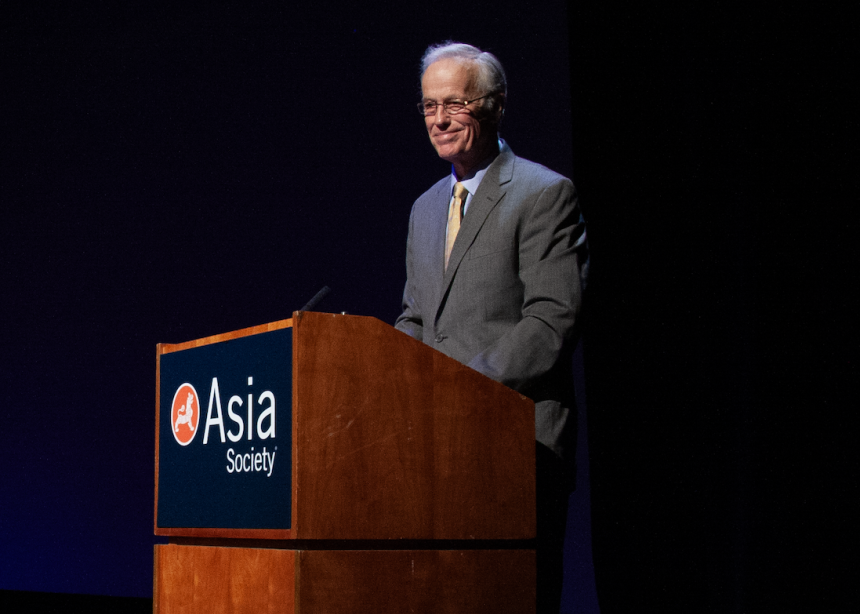
you, Ambassador Platt*. I'm very pleased to be here. And I'm
delighted that the Caspian is an area of interest to the Asia
Society. Because it is not only a fascinating place but an
area of great future importance.
The region is going through remarkable change -- that is historic
in nature, broad in scope and profound in terms of an emerging
regional identity.
I'd like to give you my perspective on energy and economic
development in the Caspian and explain why this region is
important -- to everyone who can -- and cannot -- find Azerbaijan
or Turkmenistan on the map.
The region has tremendous energy resources and tremendous
unrealized potential. It's also going through a dramatic transformation
as countries embrace freedom -- and rebuild long-neglected
industries.
* *
*
The
U.S. Energy Information Administration puts the Caspian's
proven oil reserves at 15 to 29 billion barrels -- making
it comparable to the North Sea or the United States -- and
ensuring the Caspian will be an important source of future
oil. Proven reserves are those that can be economically produced
with current technology.
However, what really excites people are that some experts
have estimated ultimate Caspian petroleum resources at 100
to 200 billion barrels of oil. That's the total of known and
possible future reserves. Although there might be some wishful
thinking in these numbers, the estimates imply that the Caspian
could become one of the world's major sources of energy.
* *
*
Chevron's
entry into Central Asia began in a remote desert just northeast
of the Caspian Sea.
In April 1993 in Almaty, Nursultan Nazarbaev, the president
of the Republic of Kazakhstan, and I signed a 40-year agreement
that formed a $20 billion partnership called Tengizchevroil,
or TCO for short. That gave Chevron a 50 percent interest
in the 6-to-9 billion barrel Tengiz Field. While it's only
been five years since this landmark venture began, we've packed
a whole lot of history into that period.
First, some background. We began negotiating with the Soviet
Union for an oil exploration and production agreement in the
late 1980s. Little did we -- or anyone -- realize what monumental
events were about to unfold.
The fall of the Berlin Wall and the breakup of the Soviet
Union left a familiar world in shreds. These changes sent
waves of shock -- then of hope -- around the globe.
All at once, a cold war ended, newly independent nations emerged
and centrally planned economies fell from favor.
At that point, we had all but signed an agreement for Tengiz
with the Soviets. Fortunately, we had involved officials of
Kazakhstan early on; so negotiations continued with the new
republic, where Tengiz is located.
Difficult as that period was, some true leaders emerged --
among them, Nursultan Nazarbaev. Because of his vision and
our persistence, Tengizchevroil became a reality in Kazakhstan's
second year of independence.
According to the conventional wisdom of the time, a major
alliance between a newly independent country and a western
corporation wouldn't work. Better to wait out the squall of
economic and political reform.
Tengizchevroil's main enterprise -- to operate the huge Tengiz
oil field -- required focus, flexibility and patience by both
partners. Meshed with the demands of business and technology
were issues of culture and custom and the newness of a world
redefining itself.
The 200 or so Chevron employees who left the U.S. and other
countries for Kazakhstan found themselves in a multilingual
world where Kazakh, Russian, Hungarian, Turkish and English
speakers toiled feverishly to create an integrated workplace.
In that environment, there was no such thing as "business
as usual." The partnership took shape just as the new
republic was being forged.
The employees did a magnificent job in taking over operation
of this huge facility, and we have a superb leadership team
taking us into the future.
In forming this alliance, we knew the risks were big -- but
so was the Tengiz Field. Chevron's share in Tengiz will ultimately
increase our oil reserves by more than 3 billion barrels.
* *
*
Forgive
me for boasting about Tengizchevroil's accomplishments. It's
been gratifying to prove the naysayers wrong. And, believe
me, the world was watching our every move.
The Tengiz Field was discovered by the Soviets in 1979. It's
a "supergiant" field -- the biggest oil find in
the last 30 years. And we haven't hit bottom yet.
Tengiz has the potential to produce up to 9 billion barrels
of oil over 40 years. That's comparable to Alaska's Prudhoe
Bay Field.
In 1993, output was about 30,000 barrels of oil a day. Last
May, we set a production record of 200,000 a day. And we expect
to be running at more than 700,000 barrels a day in 2010.
Furthermore, TCO has set an exemplary safety record: earlier
this month, employees were honored for working 5 million hours
without a lost-time injury.
To increase production capacity, the TCO partners will invest
more than $1 billion over the next three years. TCO has been
successful because -- every step of the way -- Kazakhstan
has honored its agreements with us.
And in a strong vote of confidence, Mobil and LUKARCO - which
is a joint venture of Russia's LUKoil and ARCO - have since
joined TCO. Mobil bought half of the government's 50 percent
share, and LUKARCO bought 5 percent from us.
* *
*
Producing
the oil, however, is only half the story. Getting it to the
marketplace has proved more challenging. The pipeline system
in this part of the world was designed to meet the U.S.S.R.'s
internal needs. Much of it is under Russian control.
We currently ship about 72,000 barrels of oil a day through
Russian pipelines - a limit dictated by existing capacity
and quotas. We're using Russian technology to strip Tengiz
oil of mercaptans - sulfur compounds that cannot be handled
by Russia's pipelines. On average, another 87,000 barrels
a day was transported by rail in 1997.
Tengizchevroil has shipped oil to Azerbaijan, Georgia, the
Ukraine, Finland and Estonia. We also sent a test shipment
to Urumchi, China. Oil moves over land, across the Caspian
Sea, up the Volga-Don Canal and through the Baltic, Black
and Mediterranean seas.
* *
*
Transportation
issues are key to unlocking the true wealth of this region,
and I'll discuss the major pipelines being planned. First
I want to emphasize how Tengizchevroil has been a cornerstone
of economic development in this region.
What does Tengizchevroil mean to Kazakhstan?
In 1997, it paid more than $200 million in taxes, royalties,
dividends, transport fees, community programs, and payroll.
Incidentally, the payroll consists of 3,100 employees, more
than 70 percent of whom are citizens of Kazakhstan. About
230 Chevron expatriates work for TCO, and, if you include
contractors, a total of 9,000 work on the project.
Since 1993, the venture has invested more than $1 billion
in construction, transportation, food and other services.
In that five-year period, TCO spent $50 million on programs
to improve the health, education and infrastructure of local
communities.
The benefits enjoyed by Kazakhstan are spreading throughout
the region. As new export pipelines are built, other countries
-- just beginning to see the benefits of free markets -- also
will reap rewards.
* *
*
Each
of the Caspian countries provides an important link in the
Eurasian transportation corridors -- collectively called the
new Silk Road. By cooperating with governments of the region
to transport Tengiz oil, Chevron already is proving the viability
of these corridors.
* *
*
Comparisons
of this growing network to the Silk Road of old are inevitable.
And, in fact, there are similarities.
The Silk Road began linking the Chinese and Roman empires
around 100 B.C. Despite its name, it wasn't a single artery,
but a network of routes. Based on trade in silk, glass, perfume
and horses, the Silk Road prospered, particularly in the sixth
through eighth centuries. It experienced another great age
beginning around 1260 -- and recounted, in part, by Marco
Polo.
The Silk Road of old fostered the exchange not just of commodities
but of people, customs and ideas. Likewise, the new Eurasian
transportation corridors will not just trade in oil and gas.
They will be catalysts for communication, cooperation and
broad-based commerce.
* *
*
Petroleum
has long played a role in the Caspian. Led by Azerbaijan,
this region experienced an oil boom at the turn of the century
-- a black-gold rush that came to be known as "The Great
Game." Today's commentators have latched onto that term
and take pains to draw parallels to current activities.
I think there's a big difference.
The earlier oil boom was a power play between the British
and Russian empires. Today, we stress cooperation and mutual
benefit. How else could 11 partners come together with a common
goal -- as they have in the Caspian Pipeline Consortium?
I'd like to relegate The Great Game to history and focus instead
on The Great Gain - the wealth that oil development can bring
when cooperation supersedes political rivalry and new dreams
replace old feuds.
The region has had its share of conflicts -- and divisiveness
is a continuing threat in certain areas.
Some would say that's reason not to do business in this area.
I say, all the more reason to press ahead with projects that
support economic development. There will be no lasting independence
-- no bulwark of prosperity without a strong energy infrastructure.
The economic gains that Tengizchevroil and the Caspian Pipeline
Consortium are making will spill over to other businesses,
such as manufacturing, construction and telecommunications,
as well as to a host of smaller enterprises.
The power generation, agricultural processing, mining and
steel industries already have made substantial investments
in Kazakhstan.
* *
*
Tengizchevroil
means a great deal to Russia too. TCO has spent more than
$260 million on Russian goods and services since 1993. Russian
economists point out that every Tengizchevroil dollar spent
in Russia generates more than two dollars of gross domestic
product.
Over 40 years, the project will contribute $28 billion to
the Russian Federation's GDP while adding $10 billion in revenue
to federal, regional and local governments.
No less dramatic is the impact on individuals. TCO expenditures
in Russia will sustain more than 6,500 new jobs per year.
The Russian Academy of Science estimates that the Caspian
pipeline will indirectly support more than 100,000 jobs annually
in Russia and will add $22 billion in direct government revenue.
* *
*
Clearly,
Tengizchevroil has stimulated regional growth. It also helped
pave the way for other oil projects.
It's unlikely that Azerbaijan's "deal of the century"
would have happened if TCO hadn't first succeeded. This agreement
calls for 12 partners in the Azerbaijan International Operating
Company - AIOC -- to develop 4 billion barrels of Caspian
Sea reserves.
Several other large projects closely followed AIOC. Azerbaijan
has concluded at least 15 major agreements with international
oil companies.
* *
*
President
Nazarbaev came under fire when he first invited foreign companies
into Kazakhstan, and President Aliyev of Azerbaijan has been
similarly criticized.
Both Nazarbaev and Aliyev have been resolute in their visions.
By acting now they are building a platform for growth. Last
year, Kazakhstan reported it already had attracted $7.5 billion
in foreign direct investment -- with some 40 percent in oil
and gas. To put that in perspective, Russia has attracted
about $10.5 billion in foreign direct investment since 1991.
Timing is critical for nations struggling to make the most
of new-found freedoms. The recent financial crisis in Russia
demonstrates how fragile emerging free markets can be.
Clearly, Russians are at a crossroads, and we wish them every
success in transforming their economy. What happens in Russia
is very important to us and the rest of the world. But it
doesn't change our commitment in the Caspian -- which we have
always viewed as long-term.
In light of Russia's financial troubles, it's all the more
important that pipeline projects move forward and regional
cooperation be fostered.
* *
*
Both
the Bush and Clinton administrations have been very supportive
of Caspian energy projects. The Silk Road Strategy Act, which
has many advocates in Congress, represents a commitment to
the economic and political development of the Caspian countries.
We agree with the bill's underlying philosophy -- that regional
cooperation is the basis for sustainable growth.
* *
*
One
of Chevron's key strategies is to accelerate growth in the
Caspian. That includes developing infrastructure, new markets
and regional businesses. In fact, we've formed a Caspian Action
Team charged with that responsibility.
Improving transportation and expediting pipeline construction
is a high priority. However, we're also expanding our lubricants
business in the region, have opened three service stations
in Kazakhstan and are pursuing other retail opportunities.
We're also interested in petrochemicals, because the Caspian
offers low feedstock costs and a solid labor force. We hope
to build a plant near Atyrau, Kazakhstan, to manufacture polyethylene
pipe for use in infrastructure improvement projects.
In Atyrau, Chevron also aims to assist small business owners
with loans and counseling. This would be done through a business
support center that we're setting up in conjunction with the
United Nations.
This assistance will allow, for example, local farmers to
expand their businesses and provide our Tengiz camp with food
and milk. It's a great example of mutual benefits -- for us
and for the citizens of Kazakhstan.
As part of our expanding Caspian role, we joined with Azerbaijan
and France's Total in 1997 to explore the Absheron Block,
potentially one of the Caspian Sea's most prolific fields.
We've completed a 3-D seismic survey of the area and currently
are evaluating it -- with drilling to follow.
Azerbaijan's geographic blessings make it a natural transportation
hub. The country will play a key role in producing and transporting
petroleum and in ensuring regional stability.
* *
*
Let's
take a look at the major pipeline projects being planned.
· An export pipeline, planned by the Caspian Pipeline
Consortium and costing more than $2 billion, will connect
Tengiz to the Russian Black Sea port of Novorossiysk in 2001.
The initial capacity of 560,000 barrels a day is expected
to more than double by 2014.
From Novorossiysk, tankers will move oil to Black Sea and
Mediterranean markets.
Chevron has a 15 percent stake in the consortium, and we strongly
support this route as the most economic means for exporting
Tengiz oil. But we recognize that, as more oil is produced,
multiple routes will be best for the region and for an oil-dependent
world.
It's estimated that the Caspian will need more than 2 million
barrels a day of new export capacity over the coming decade.
· AIOC is involved in two projects: The first is an
upgrade of a 900-mile pipeline -- already in use by AIOC --
from Baku to Novorossiysk.
The second project is to build a new pipeline from Baku to
the Georgian Black Sea port of Supsa. This route should be
completed by year-end.
Each line will be able to move more than 100,000 barrels of
oil per day.
· Chevron is working to increase the capacity of the
system that links Baku to the Georgian port of Batumi.
Tengizchevroil is already using this route. It ships oil by
rail to the Kazakh city of Aktau, then by small vessels across
the Caspian, and from Baku to Batumi using rail and pipeline.
· Receiving great attention is a potential route from
Baku to Ceyhan, Turkey, on the Mediterranean. And, as you
can see, there are several suggested ways to link the two
cities. Proponents point out that shipments to Ceyhan will
help alleviate congestion in the Bosphorus.
This line will be part of a long-term transportation solution,
but I think it's most important that we focus on completing
pipeline projects already well under way.
* *
*
Many
other pipelines have been proposed.
China recently became active in the Caspian. In a $9.5 billion
agreement, China plans to develop onshore oil in Kazakhstan
and envisions building, in several stages, a 2,000-mile pipeline
that would carry Kazakh oil to western China.
In the coming decades, oil demand is expected to grow faster
in China than anywhere else, due to rapid industrialization.
Because China and other Far East nations are very dependent
on Persian Gulf oil, they -- like the U.S. -- are interested
in diversifying their energy supplies.
Iran also is part of the transportation equation. As a U.S.
company, Chevron is governed by American sanctions against
Iran, and, until those are lifted, our interest in this route
is necessarily restricted.
However, some companies plan to deliver oil to Iranian terminals
on the Caspian in exchange for oil at points on the Persian
Gulf. Iran also plans to upgrade its existing pipelines between
the Caspian and the Gulf.
* *
*
Not
every proposed pipeline will become a reality, but clearly
a new transportation network, driven by petroleum projects,
is coming to life.
* *
*
The
oil industry's re-emergence as a strong force in the Caspian
is one of the great stories of our day. As oil projects succeed,
investor confidence will rise, allowing the region to diversify
its economy and open doors to a new generation of entrepreneurs.
* *
*
This
region was described in the 13th century -- and still is today
-- as a link between East and West, a fulcrum between two
powers.
But the Caspian is more than a stopping point on the way to
somewhere else. It's a rich, dynamic region in its own right
-- a region whose natural resources are complemented by a
wealth of cultures and a collective will to join the global
economic community.
In Central Asia, we understand the importance of working with
both national and local leaders -- the importance of being
a part of the community, not just a passer-by.
In Kazakhstan, people know us for our oil field technology,
but equally for our high environmental and safety standards.
They also know us as the people who built houses for flood
victims, provided a heating plant and a bakery for the town
of Atyrau. They know us as the people who support medical
clinics, orphanages and schools.
Technical and business skills count for much. So, too, do
commitment and credibility.
No one living in the Caspian countries expects things to remain
the same. Change has become a constant. Imagine, then, how
important a long-term commitment is -- how important is that
strand of security in a turbulent environment.
Commitment in the Caspian goes beyond the daily demands of
business, beyond the complexities of politics and beyond the
fits and starts of new economies.
It means supporting -- long-term -- the independence of Caspian
states. It means promoting regional cooperation. It means
ensuring energy security and increasing and diversifying world
energy supplies.
Commitment doesn't come easy. But, like the many great efforts
that advance nationhood and support meaningful economic transitions,
it is essential -- and it is, ultimately, rewarding.
Thank you very much.
For more
information on Chevron visit their website.
low honorees,
members of the Asia Society and guests. I am very pleased
to be here.
|