Chinese Calligraphy
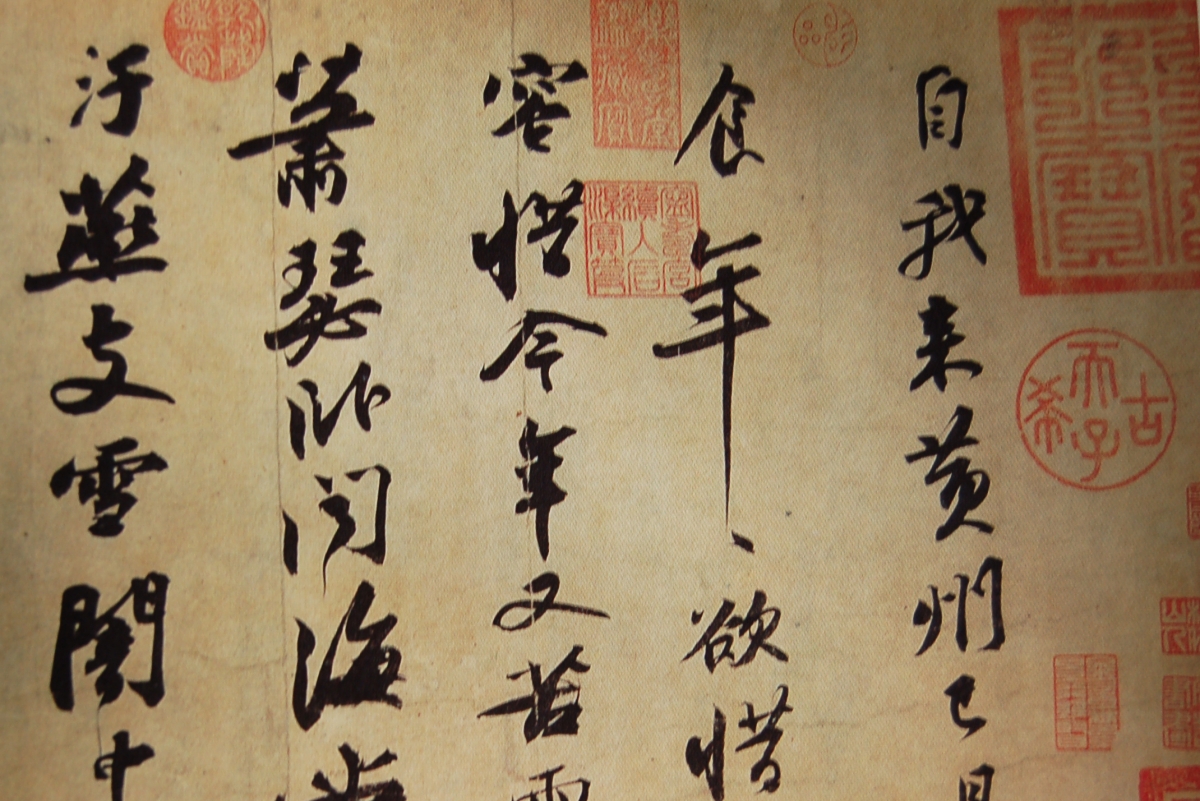
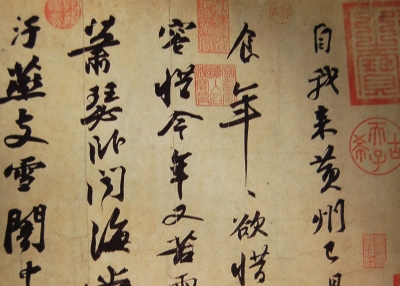
Calligraphy, literally "beautiful writing," has been appreciated as an art form in many different cultures throughout the world, but the stature of calligraphy in Chinese culture is unmatched. In China, from a very early period, calligraphy was considered not just a form of decorative art; rather, it was viewed as the supreme visual art form, was more valued than painting and sculpture, and ranked alongside poetry as a means of self-expression and cultivation. How one wrote, in fact, was as important as what one wrote. To understand how calligraphy came to occupy such a prominent position, it is necessary to consider a variety of factors, such as the materials used in calligraphy and the nature of the Chinese written script as well as the esteem in which writing and literacy are held in traditional China.
The earliest extant examples of Chinese writing are the inscriptions that appear on so-called oracle bones (animal bones and turtle shells) and on bronze vessels, the oldest of which date back to the Shang dynasty (ca.1600-ca.1100 B.C.E.). Shang kings used these objects in important divination rituals, and some scholars have argued that this early association of writing with ritual and political authority helps to account for the special status conferred upon those who could read and write.
These early inscriptions were made on the surface of an oracle bone or a bronze mold with a sharp, pointed instrument. As a result of this process, the characters (or "graphs" as they are also called) generally lack the kinds of linear variation and other attributes considered prerequisites of true calligraphy. Those qualities began to emerge very clearly during the Han dynasty (206 B.C.E.-220 C.E.), when Chinese artisans perfected the manufacture of the basic materials still used by calligraphers today: brush, ink, paper, and inkstone.
Although archaeological evidence confirms that brushes were known in China at a much earlier date, it was during the Han period that their use became widespread. A typical brush consists of a bundle of animal hairs (black rabbit hair, white goat hair, and yellow weasel hair were all very popular) pushed inside a tube of bamboo or wood (though jade, porcelain, and other materials were also occasionally used). The hairs are not all of the same length; rather, an inner core has shorter hairs around it, which in turn are covered by an outer layer that tapers to a point. Brushes come in a wide variety of shapes and sizes that determine the type of line produced. What all such brushes have in common, however, is their flexibility. It is this feature more than any other that allows the calligraphic line to be so fluid and expressive.
The ink employed in calligraphy is usually made from lampblack, a sooty residue created by burning pine resin or oil underneath a hood. After being collected, the lampblack is mixed with glue and then pressed into molds. The resulting hardened cakes or sticks can then be ground against a stone and mixed with water, a process that allows the calligrapher to control the thickness of the ink and density of the pigment. Eventually ink cakes and ink sticks themselves became a decorative art form, and many well-known artists created designs and patterns for their molds.
The invention of paper is widely appreciated as one of China's major technological contributions to the world. Tradition credits the discovery of the process to Cai Lun in 105 C.E., though recent tomb findings demonstrate that paper was known at least a century earlier. Paper was made from various fibers, such as mulberry, hemp, and bamboo, and provided an inexpensive alternative to silk as a ground material for calligraphy and painting.
Together with the inkstone—a carved stone slab with a reservoir for grinding ink and mixing it with water—brush, ink, and paper are known in China as the Four Treasures of the Study (wenfang sibao), indicating the high esteem in which the materials of calligraphy are held. These Four Treasures are the same materials employed by traditional Chinese painters. Some critics have pointed to this as a way of explaining why calligraphy has a higher status in China than elsewhere. The argument goes something like this: In Europe, for instance, painting is a high art; calligraphy does not use the same materials as painting; therefore, calligraphy is not accorded the same high status as painting. In China painting and calligraphy use the same materials; therefore, calligraphy is considered to be a high art akin to painting.
The problem with this argument is its basis upon the unfounded assumption that painting in China, as in Europe, was the most valued visual art form. In fact painting in China practically from its inception was considered secondary to calligraphy as a visual art. Moreover the argument that painting and calligraphy share the same materials was used in the eleventh and twelfth centuries to elevate the status of painting, rather than the other way around.
In trying to understand why calligraphy came to occupy such a prominent position in China, it is useful to consider the features that were prized when calligraphy began to emerge as an art form distinct from mere writing; that is to say, when specimens of handwriting began to be valued, collected, and treated as art. One of the earliest recorded instances concerns the first-century emperor Ming of the Han, who, upon hearing that his cousin was on his deathbed, dispatched a messenger to obtain a piece of his writing before he passed away. By so doing, Emperor Ming was hoping to be able to "commune" with his relative, even after death, through the traces of his personality embodied by his calligraphy.
More than any other factor, it is the claim that calligraphy can serve as a medium of revelation and self-expression that best accounts for why it became so highly esteemed. A brief consideration of how calligraphic technique is mastered might shed some light on the question of why such expressive potential was seen as intrinsic to calligraphy in the first place.
As discussed elsewhere, the Chinese written script is made up of several thousand individual graphs. Each consists of an invariable group of strokes executed in a set order. One of the truly unique features of calligraphy that results from these apparently restrictive guidelines is that the viewer is able to mentally retrace, stroke by stroke, the exact steps by which the work was made. The viewer also is able to observe extremely subtle nuances of execution-where a stroke was made swiftly or slowly, whether the brush was put to the paper with great delicacy or force, and so on.
The ability to perform this retracing personalizes the viewing experience and generates in the viewer the sense of interacting or communing with the absent calligrapher. At the same time it is precisely the nuances of execution, those individualized deviations from the set form, that separate good calligraphy from bad handwriting. Furthermore, since everyone who is taught to read and write learns the same basic procedures, often by literally tracing famous examples of calligraphy, every educated person is to a significant extent able to perceive and appreciate the achievements of a great calligrapher.
The evaluation of calligraphy thus clearly had an obvious social dimension, but it also had an important natural dimension that should not be overlooked. For example, early critics and connoisseurs often likened its expressive power to elements of the natural world, comparing the movement of the brush to the force of a boulder plummeting down a hillside or to the gracefulness of the fleeting patterns left on the surface of a pond by swimming geese. Writing also would frequently be described in physiological terms that invoked the "bones," "muscles," and "flesh" of a line. In short, while calligraphy involves the Confucian emphasis on the social, this cannot be separated from a more Daoist emphasis on the workings of nature.
Although the practice and appreciation of calligraphy are often presented as essentially traditional pursuits, calligraphy is present in modern China in various ways. Indeed, the single most commonly reproduced example of calligraphy is undoubtedly the four character phrase (Renmin Ribao, "The People's Daily") that to this day appears on the masthead of every copy of the official newspaper of the PRC-four characters originally brushed by Chairman Mao himself. Also, as several recent exhibitions of modern Chinese art have demonstrated, many contemporary avant-garde artists continue to engage and question the cultural authority associated with the "beautiful writing" of the past two thousand years.
Suggested further readings
Billeter, Jean François. The Chinese Art of Writing. New York: Skira/Rizzoli, 1990.
Harrist, Robert, and Wen Fong. The Embodied Image: Chinese Calligraphy from the John B. Elliott Collection. Princeton: Art Museum, Princeton University in association with Harry N. Abrams, 1999.
Kraus, Richard Curt. Brushes with Power: Modern Politics and the Chinese Art of Calligraphy. Berkeley: University of California Press, 1991.
Sullivan, Michael. The Three Perfections: Chinese Painting, Poetry, and Calligraphy. Rev. ed. New York: George Braziller, 1999.
Yee, Chiang. Chinese Calligraphy: An Introduction to Its Aesthetics and Technique. Cambridge, MA: Harvard University Press, 1973.
Author: Charles Lachman.