Asian Americans Then and Now
Linking Past to Present
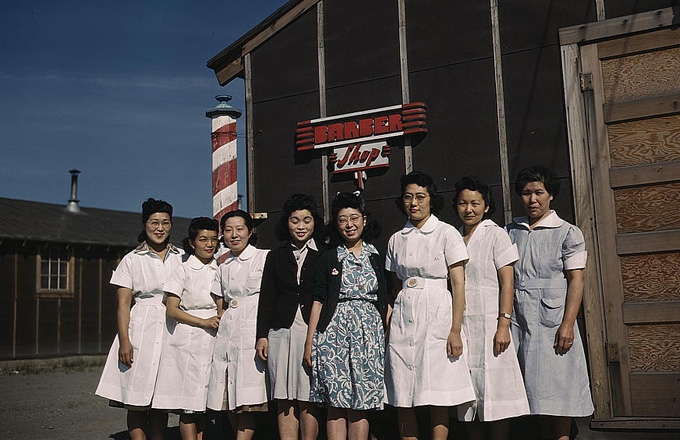
A look at the long history of Asian Americans and its role in shaping US identity. The essay also looks at the push-pull factors that have helped define demographic trends in the United States to present day and also covers some darker periods of American history, including the Congressional Exclusionary Act restricting immigration based on race and the Japanese American Internment during WWII.
Our children should not be placed in any position where their youthful impressions may be affected by association with pupils of the Mongolian race. —San Francisco School Board, 1905
In response to the challenge of changing demographics more than a century ago, the San Francisco School Board established a segregated Chinese Primary School for Chinese children to attend, including those who were American-born. By the turn-of-the century after Japanese immigrants had settled in the wake of Chinese exclusion, the School Board also applied the Chinese segregation policy to Japanese students. School superintendent, Aaron Altmann, advised the city's principals: "Any child that may apply for enrollment or at present attends your school who may be designated under the head of 'Mongolian' must be excluded, and in furtherance of this please direct them to apply at the Chinese School for enrollment."
Throughout their history, Asian Americans have confronted a long legacy of exclusion and inequity in relation to school policies and practices, particularly during periods of changing demographics, economic recession, or war. In spite of historic, linguistic differences, distinct Asian nationalities have been grouped together and treated similarly in schools and in the larger society. The grouping of Asian Americans together, then, makes sense in light of historic links from the past to the present.
Beginning in the 1850s when young single men were recruited as contract laborers from Southern China, Asian immigrants have played a vital role in the development of this country. Working as miners, railroad builders, farmers, factory workers, and fishermen, the Chinese represented 20% of California's labor force by 1870, even though they constituted only .002% of the entire United States population. With the depression of 1876, amidst cries of "They're taking away our jobs!," anti-Chinese legislation and violence raged throughout the West Coast.
In 1882, Congress passed the Chinese Exclusion Act—the only United States Iaw to prevent immigration and naturalization on the basis of race—which restricted Chinese immigration for the next sixty years. The "Chinese Must Go" movement was so strong that Chinese immigration to the United States declined from 39,500 in 1882 to only 10 in 1887.
By 1885, following Chinese Exclusion Act, large numbers of young Japanese laborers, together with smaller numbers of Koreans and Indians, began arriving on the West Coast where they replaced the Chinese as cheap labor in building railroads, farming, and fishing. Growing anti-Japanese legislation and violence soon followed. In 1907, Japanese immigration was restricted by a "Gentleman's Agreement" between the United States and Japan.
Small numbers of Korean immigrants came to Hawaii and then the mainland United States following the 1904-1905 Russo-Japanese War and Japan's occupation of Korea. Serving as strike-breakers, railroad builders, and agricultural workers, Korean immigrants faced not only racist exclusion in the United States but Japanese colonization at home. Some Korean patriots also settled in the United States as political exiles and organized for Korean independence.
South Asian Indian immigrants also entered the United States as laborers, following Chinese exclusion. Recruited initially by Canadian-Pacific railroad companies, a few thousand Sikh immigrants from the Punjabi region immigrated to Canada which, like India, was part of the British empire. Later, many migrated into the Pacific Northwest and California, and became farm laborers. Ironically decried as a "Hindu invasion" by exclusionists and white labor, the "tide of the Turbans" was outlawed in 1917 when Congress declared that India was part of the Pacific-Barred Zone of excluded Asian countries.
By 1924, with the exception of Filipino "nationals," all Asian immigrants, including Chinese, Japanese, Koreans, and Indians were fully excluded by law, denied citizenship and naturalization, and prevented from marrying Caucasians or owning land.
With all other Asians excluded, thousands of young, single Filipinos began migrating in large numbers to the West Coast during the 1920s to work in farms and canneries, filling the continuing need for cheap labor. Filipinos were not legally excluded by the immigration laws because the Philippines was already annexed by the United States as a result of the 1898 Spanish-American War. Racism and economic competition, intensified by the depression of 1929, however, led to severe anti-Filipino violence and passage of the Tydings-McDuffie Act of 1935 which placed an annual quota of fifty on Filipino migration—effectively excluding their entry as well. During the half century from 1882 to 1935, three waves of early Asian immigrants contributed their labor to the building of this country but were eventually denied entry and not granted naturalization rights until 1952. Though coming from different countries and cultures, the pioneering Chinese, Japanese, Koreans, Indians, and Filipinos each faced similar conditions of exclusion which forged the beginnings of a common, shared Asian experience in America.
There are important parallels between European and Asian immigration history, especially in terms of how individuals responded to the "pushes" and "pulls" in their homelands and then faced contadictory experiences of discrimination and opportunity the U.S. However, the "push-pull" model commonly used to explain European immigration, like the melting pot paradigm of immigrant assimilation, does not explain the fundamental differences in patterns of Asian immigration and exclusion.
These differences can only be understood by recognizing critical features of the historical period, including:
- the reality of western colonialism and unequal power relations in Asia;
- the insatiable need for cheap labor that accompanied manifest destiny westward expansion and economic development in the United States; and
- the influence on social policy and public attitudes that resulted from lack of knowledge about Asian peoples, and racist notions of white superiority.
Though many are familiar with Ellis Island as a symbol of America's immigration history, few realize that Angel Island—a comparable immigration detention center for the West Coast—was the site where immigration policy was enforced during the Asian exclusion years. Angel Island represents an important counterpoint to Ellis Island and the saga of American immigration history.
Between 1910 and 1940, hopeful Chinese immigrants were detained at Angel Island where they were required to undergo humiliating medical examinations and detailed interrogations. Questions ranged from "What are the birthdates of each member of your family?" to "Who lived in the third house of the second row of your village?" Failed answers were grounds for continued detainment and eventual deportation back to China.
In 1970, a park ranger discovered sets of Chinese characters carved into the wooden walls of the barracks. Now recognized as an historic Iandmark, the Angel Island detention center bears witness to the bitterness and frustration of excluded Chinese immigrants who carved more than one hundred poems into the walls.
Although minor reforms in immigration law, due to changing international relations, allowed for limited numbers of Asians to enter the United States following the World War II era, United States immigration laws remained discriminatory toward Asians until 1965 when, in response to the civil rights movement, non-restrictive annual quotas of 20,000 immigrants per country were established. For the first time in United States history, large numbers of Asians were able to come to the United States as families. In addition, due to the United States' eagerness for technology during the Cold War, foreign engineers and scientists were also encouraged to emigrate to the United States. The dramatic changes in the Asian Pacific American landscape during the past twenty years, particularly with the explosive growth of new Filipino, Korean, South Asian Indian, and Chinese populations have resulted from the liberalization of immigration laws in 1965.
Beginning in 1975, Southeast Asian refugees from Vietnam, Cambodia, and Laos have entered the United States after escaping from war, social chaos, discrimination, and economic hardship. Roughly one million Southeast Asians, including about 30,000 Amerasian children of American servicemen and their families, have entered the United States since then through a variety of refugee resettlement and immigration programs.
Refugees from Vietnam, Cambodia, and Laos each have distinct cultures, languages, and contexts of historical development. Although each country shares certain influences from their common history as a French colonial territory for nearly a century until 1954, Vietnam is much more culturally influenced by China while Cambodia and Laos have been more influenced by India. Within each country, there are Chinese and other ethnic minority populations such as the Hmong, Mien, and Khmer from Laos.
Many cases also link the present to the past. The experiences of personal struggle, economic contribution, racial harassment, and discriminatory legislation targeting Vietnamese fishermen in California's Monterey Bay during the 1980s, for example, are almost identical to those of earlier generations of Japanese and Chinese fishermen who successively fished in Monterey Bay during the late 1800s and early 1900s.